A rooftop greenhouse is a commercial greenhouse built on top of an existing building, such as a grocery store, restaurant, apartment building, hospital, or warehouse, rather than on undeveloped land. Cities are increasingly turning to this approach to bring food production closer to where people live, moving beyond smaller-scale efforts like community farms in empty lots and green roofs toward large-scale rooftop greenhouses capable of producing food for urban communities year-round.
What Are the Benefits of Rooftop Greenhouses?
Creating local food systems
Energy savings for the structure underneath
Water savings by collecting and using rainwater
Improved air quality in cities
Land savings
Transportation savings, including fewer food miles
Increased property value for surrounding properties
Reduced heat island effect
Support for a local food community
Increased food quality, year-round
Creating Local Food Systems
In 2020, Lufa Farms opened what was then considered the world’s largest rooftop greenhouse, on top of a warehouse facility in Montreal, Canada. According to Agritecture, this farm harvested enough vegetables each week to feed 20,000 nearby families at an affordable price. While that’s a small share of the city’s population, it demonstrates that this type of food production is viable and can meaningfully supplement traditional agriculture.
Bringing greenhouses into cities gives people closer access to fresh produce and more visibility into how their food is grown. Rooftop greenhouses build local food systems, which can improve community health and reduce dependence on imported produce.
Energy Savings
Heating and cooling commercial buildings in cities is expensive. A rooftop greenhouse can help offset those costs: on a sunny winter day, a greenhouse can help heat the building below, and in summer, it can help cool it. A rooftop greenhouse can make the building underneath it more energy efficient.
Water Savings
Urban areas can experience significant water runoff during heavy rainstorms, which then needs to be treated at wastewater treatment plants. Rooftop greenhouses can collect and store rainwater instead, which can be used to irrigate plants or serve as gray water for bathrooms and building utilities.
Improved Air Quality
A greenhouse full of plants generates oxygen that’s released into the surrounding air, improving air quality, and greenhouse air is also filtered to remove particulate matter. On top of a grocery store, restaurant, hospital, or other space with heavy foot traffic, that clean, oxygenated air can be filtered back into the building to make the space more comfortable.
Land Savings
Gotham Greens built its first hydroponic greenhouse on top of a Whole Foods in New York City after being priced out of the NYC real estate market. Building on top of an existing structure, a grocery store in this case, helped its business viability in more ways than one: the greenhouse provides fresh greens year-round to that Whole Foods and other local restaurants in the area. Rooftop greenhouses are one solution to limited land availability and rising real estate prices in cities.
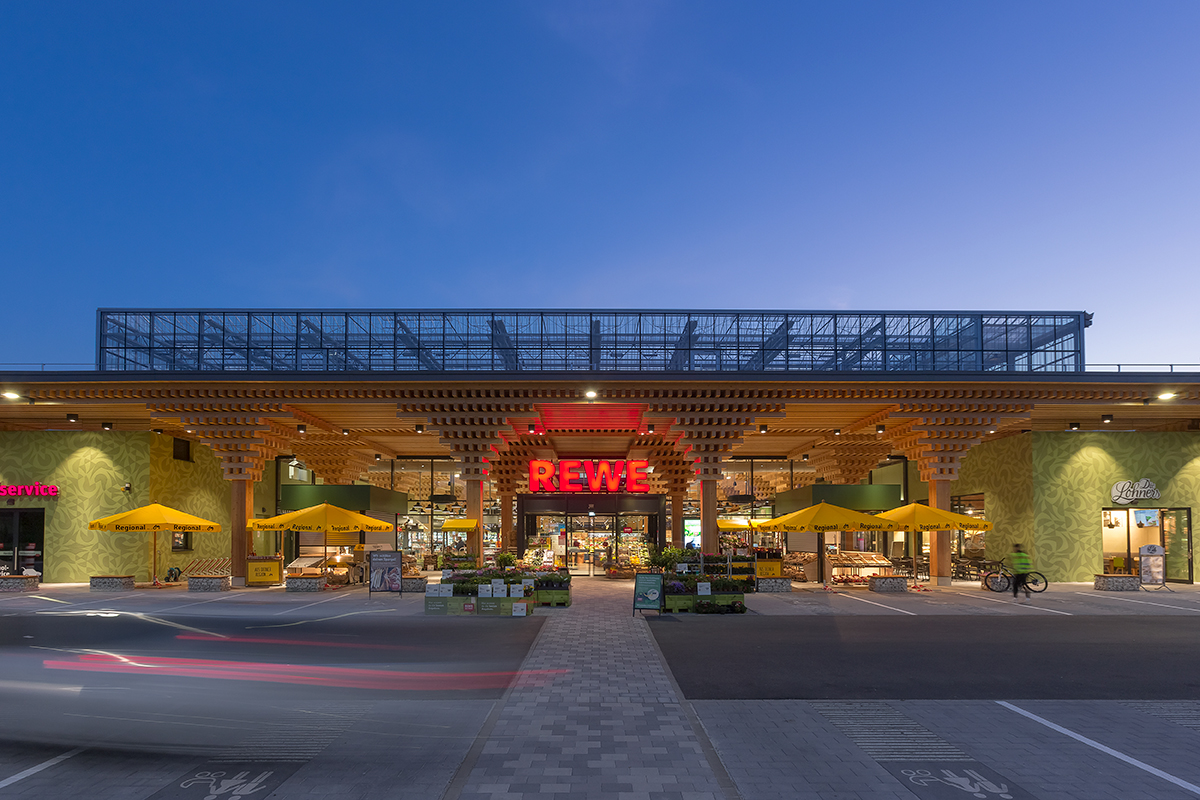
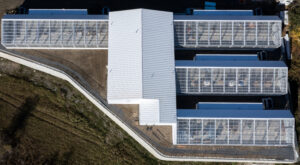
Rewe Market in Wiesbaden, Germany, is another example of a space-saving rooftop greenhouse: a rooftop aquaponics greenhouse supplies the region with fresh greens and fish. The supermarket, including the rooftop greenhouse, covers roughly 25,000 sq ft (2,500 m²) and was built within one year, using approximately 1,100 cubic meters of timber that stores more than 700 tonnes of CO2 as part of its construction.
Rewe Marketplace in Wiesbaden, Germany, photo by Jurgen Arlt www.arlt-photodesign.de
Transportation Cost Savings and Decreased Food Miles
More than 90% of the harvested lettuce area in the US is in California and Arizona, according to the 2022 USDA Census of Agriculture, meaning lettuce sold in a city like New York typically travels thousands of miles before reaching a grocery store. Europe shows a similar concentration: Spain has accounted for roughly half of the EU’s lettuce production and exports for the past two decades, according to Eurostat-based reporting. A rooftop greenhouse shortens this distance, reducing the environmental and economic cost of food transportation.
Increased Property Value
A rooftop greenhouse that supplies food to the community is often seen as a valuable asset and can increase property values nearby. This can be especially meaningful for economically disadvantaged neighborhoods, where a rooftop greenhouse can support community engagement, job opportunities, local food production, and homeownership over time.
The Ceres Solution
At Ceres, our goal is to create energy-efficient growing spaces for a wide range of applications. We expect the future of farming to include more CEA facilities closer to population centers, and designing rooftop greenhouses is part of how we’re bringing that shift to urban areas. Our standard greenhouse kits can be designed to fit on rooftops, empty lots, or other urban sites. Ceres also partners with European manufacturer Rabensteiner to provide custom glass greenhouse solutions engineered specifically for rooftop spaces. If you’re interested in a rooftop greenhouse design, contact us today.
Why energy performance is decided long before construction begins
An energy-efficient commercial greenhouse uses less energy per square foot of production without a reduction in crop performance. This is not a feature added after construction or a piece...
A university research greenhouse needs multiple, isolated climate zones, not the single shared environment that works for a teaching or production greenhouse. That difference drives nearly every other design decision, from HVACD systems to glazing to...
Greenhouse owners increasingly need more than an operating cost projection. Lenders, institutional partners, and public-sector clients are asking for documented sustainability performance, a credible electrification pathway, and, in some cases, the technical...
Humidity is one of the most difficult variables to manage in a commercial greenhouse, and one of the easiest to get wrong in a design that hasn’t been simulated. A structure sized correctly for heating and cooling can still struggle with humidity...
Every piece of mechanical equipment in a greenhouse comes with performance data from the manufacturer. Heating capacity, cooling capacity, coefficient of performance, airflow rate, energy recovery efficiency — all documented at standard conditions. Those...
Greenhouse ventilation design typically begins with a standard set of calculations — vent area sized to peak summer load, and openings and circulation fans positioned based on established practice. This approach addresses the conditions it is designed...
Energy is consistently one of the largest operating costs in commercial greenhouse and controlled-environment agriculture (CEA) production. Heating, cooling, ventilation, dehumidification, and supplemental lighting collectively account for a substantial...
Client: KWS Seeds
Location: Kimberly, Idaho
Partners: Starr Corporation (General Contractor)
Project Type: Commercial research greenhouse – new construction
Date: July 2026
Project Overview
When KWS Seeds set out to expand its breeding...
Kit homes, modular homes, and stick-frame construction are three distinct building methods, and each affects your budget, timeline, and labor requirements differently. This guide compares one kit-home option, the Ceres Vesta™ product line, against modular...