Every piece of mechanical equipment in a greenhouse comes with performance data from the manufacturer. Heating capacity, cooling capacity, coefficient of performance, airflow rate, energy recovery efficiency — all documented at standard conditions. Those conditions rarely reflect how the equipment will actually operate in the field.
A heat pump specified for a commercial greenhouse in Minneapolis will spend very little of its operating life at the rated test condition. It will run at part load through most of spring and autumn. It will operate against outdoor temperatures well below what the manufacturer’s rated condition assumes in winter. Its actual seasonal performance will differ from the datasheet. HVAC system simulation is how Ceres models that difference before equipment is selected.
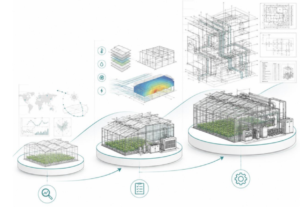
This is Part 3 of the Inside the Model series. Parts 1 and 2 covered dynamic thermal simulation and natural ventilation modeling. The load and free-cooling data from those analyses feed directly into the HVAC system simulation covered here.
What HVAC system simulation covers
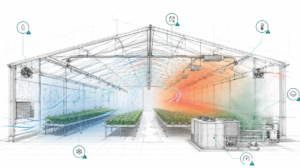
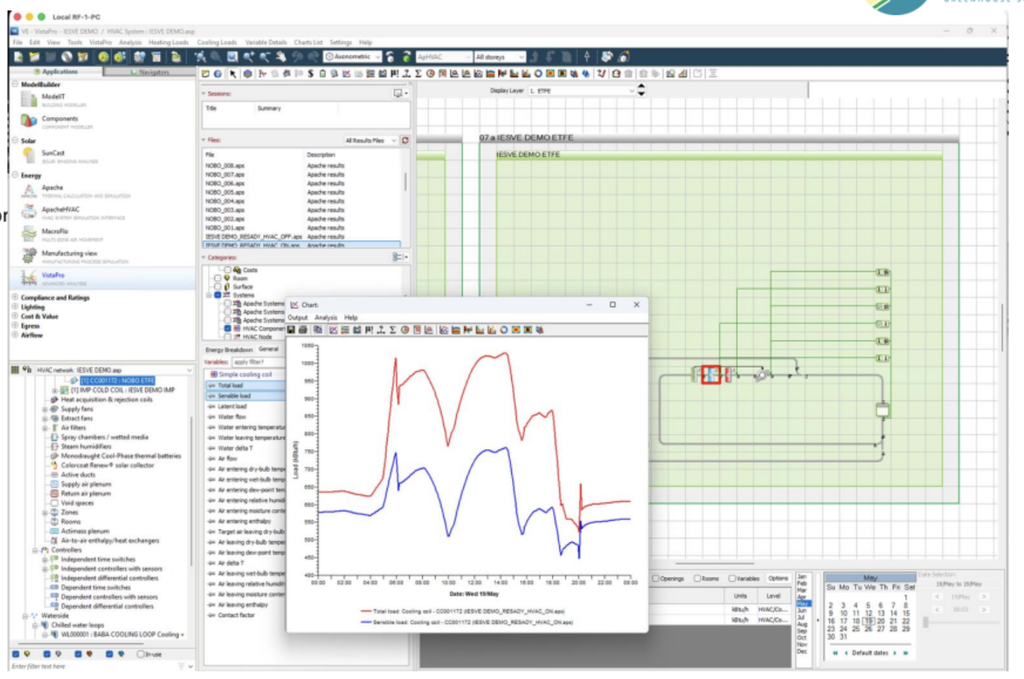
Ceres uses ApacheHVAC, the mechanical system simulation module within IESVE, to model how heating, cooling, and dehumidification equipment performs across a full year of site-specific operating conditions. Rather than applying manufacturer ratings at peak load, the simulation evaluates system behavior hour by hour, at the modeled load levels and outdoor conditions the equipment is expected to encounter at your specific site.
The distinction matters because greenhouse mechanical systems rarely operate at peak load. A heating system specified for a January design day will spend most of its runtime at part load during milder conditions. Understanding how the system behaves across the full operating range determines whether the specification is appropriate.
Manufacturer ratings describe what equipment does under test conditions. Simulation describes what it’s expected to do under your conditions.
What the simulation evaluates
- Hydronic heating systems: pipe sizing, flow rates, distribution efficiency, and the interaction between heat source output and building thermal demand across seasonal conditions
- Heat pumps and chillers: capacity and COP modeled across the full range of outdoor temperatures and load levels the system will encounter, not at the rated test condition
- Dehumidification systems: capacity validation against latent load profiles — driven primarily by crop transpiration — from thermal and humidity analysis, ensuring the system is sized for modeled moisture conditions rather than a single worst-case scenario
- Energy recovery ventilation: modeled heat and moisture transfer rates under representative ventilation conditions, quantifying the modeled energy recovery contribution rather than applying a generic efficiency factor
- Central plant integration: how multiple systems interact at the building level, including sequencing of heating and cooling sources and the effect of each on overall plant efficiency
- Thermal storage: demand shifting potential quantified from simulated load profiles, including the effect on peak demand and the interaction with utility rate structures
- Control sequence evaluation: how different control strategies affect energy consumption and environmental conditions, including heating setpoint schedules, ventilation staging thresholds, and dehumidification trigger points
Why nameplate performance is not sufficient for greenhouse specification
Mechanical equipment manufacturers test and rate their products under standardized conditions. Those conditions produce consistent, comparable ratings. They do not reflect the operating conditions of any specific building.
Part-load operation
Greenhouse HVAC systems operate at full load for a relatively small portion of their runtime, during peak winter or summer conditions. The majority of operating hours occur at intermediate loads, where equipment efficiency can differ from peak ratings. A heating system with a high rated COP may have lower seasonal efficiency if it is oversized for the actual load and cycles frequently at part load. Simulation models the full annual load profile and evaluates system performance against it.
Site-specific outdoor conditions
Heat pump performance is sensitive to outdoor temperature. A unit rated at a particular COP at 47°F will perform differently at 15°F and at 65°F. A greenhouse in a cold climate will encounter a distribution of outdoor temperatures across the heating season that differs substantially from the test condition. Dynamic thermal simulation, covered in Part 1, establishes the site-specific climate data that feeds this analysis.
System interactions
In a greenhouse, mechanical systems do not operate independently. The heating system affects indoor temperature. Indoor temperature affects ventilation demand. Ventilation rate affects the latent load on the dehumidification system. The dehumidification system produces heat that affects the space temperature. Specifying each system individually against its own peak load produces a combination that may not function as intended when all systems are operating simultaneously.
The connection to earlier simulation work
The load data that drives HVAC system simulation comes from the dynamic thermal simulation and natural ventilation modeling covered in the earlier posts in this series. Peak heating and cooling loads from thermal simulation set the upper bound for equipment sizing. Free-cooling potential from ventilation modeling reduces the mechanical cooling load. The HVAC simulation then models how the selected equipment performs against those inputs across the full year.
| Without HVAC system simulation | With HVAC system simulation |
|---|---|
| Equipment sized to peak load only | Equipment sized to full annual load profile |
| Manufacturer ratings at standard conditions assumed | Performance modeled at representative site conditions and part load |
| Heating and cooling systems specified independently | Heating, cooling, and dehumidification evaluated as integrated |
| Heat pump performance estimated from datasheets | COP and capacity modeled across seasonal operating range |
| Energy recovery value estimated or ignored | Energy recovery savings quantified under modeled ventilation rates |
| Thermal storage sized by convention | Demand shifting potential quantified from simulated load profiles |
| Control strategy assumed adequate | System behavior under different control sequences modeled |
Heat pump and geothermal system modeling
Heat pumps are a common mechanical system choice for commercial greenhouse heating, for both energy performance and electrification reasons. The performance advantage of a heat pump over a gas system depends on the outdoor temperature range at the project site and the load profile of the building. Simulation quantifies that advantage under site-specific conditions rather than assumed ones.
For projects incorporating Ceres’ proprietary GAHT® geothermal heating and cooling system, HVAC system simulation plays a particularly important role. The GAHT® system exchanges heat with the ground at a relatively stable temperature, which affects its performance characteristics differently from an air-source heat pump. Modeling the interaction between geothermal exchange, the building thermal load, and supplementary mechanical systems produces a complete picture of how the integrated system performs across seasons.
HVAC Simulation and Utility Rebates
Some utility rebate programs for commercial HVAC equipment call for documented energy modeling as part of the application, and requirements vary by utility and program. The HVAC system simulation Ceres produces as part of the design process generates the performance data that supports those applications, including seasonal energy consumption, peak demand figures, and system efficiency metrics. Ceres supports clients through the rebate documentation process.
What does this mean for your project?
HVAC system simulation produces information that affects equipment selection, capital cost, and long-term operating expenses.
Equipment selection
Simulation-derived load profiles provide the basis for selecting equipment appropriately sized across the full range of operating conditions, not just at peak. This affects both the initial specification and the efficiency the system delivers over its service life.
Capital cost
Oversized mechanical equipment costs more to purchase. A system specified from simulation-derived loads is sized to the load profile it is expected to see across the year, rather than a conservative peak-only estimate — which often means a smaller system, but the larger benefit is a specification that matches how the equipment is expected to run.
Heat pump feasibility
For projects considering heat pump technology, simulation quantifies the seasonal performance at the specific site, accounting for the outdoor temperature distribution the system is expected to encounter. This supports a defensible business case for the technology choice.
GAHT® integration
For projects incorporating the GAHT® system, simulation models the interaction between ground-to-air exchange and mechanical system operation across seasonal conditions, informing both system sizing and control strategy.
Energy cost projections
Hour-by-hour energy consumption data from system simulation produces more accurate utility cost projections than peak-load estimates. These support business case development, lender documentation, and utility rebate applications.
Control strategy
The simulation evaluates how different control sequences affect energy consumption and environmental conditions. This informs the control strategy delivered with the system, rather than leaving it to be configured at commissioning.
Next in the series: humidity and environmental control analysis
Part 4 of Inside the Model covers humidity and environmental control analysis: how latent loads are modeled, how dehumidification systems are sized against modeled moisture conditions, and how condensation risk is identified before it becomes a crop or structural problem.
| ALSO IN THIS SERIES Part 1 — Dynamic Thermal Simulation Part 2 — Natural Ventilation Modeling and CFD Airflow Analysis Part 3 — HVAC System Simulation: Real Performance vs. Nameplate Data (this post) Part 4 — Humidity and Environmental Control Analysis Part 5 — Sustainability, Electrification, and Utility Incentives |
| Ready to see your greenhouse modeled before you build it? Download the free Greenhouse Performance Guide — or speak with a Ceres engineer about your project. |
Or read more about Energy Modeling here.