What is Agritech?
Agritech, short for agricultural technology, is the integration of technology into farming and food production systems to improve efficiency, yields, sustainability, and resilience. It includes environmental sensors, automated irrigation, data analytics, and controlled-environment growing systems such as greenhouses.
Farming has traditionally depended on experience, intuition, and physical labor. Today, growers face labor shortages, climate instability, water scarcity, rising energy costs, and pressure to produce food closer to population centers. Agritech responds to these pressures by making growing systems more connected, data-driven, and precise.
Has Agriculture Always Used Technology?
Agriculture has evolved alongside technology throughout its history. Irrigation systems, tractors, greenhouses, mechanized harvesting, and climate controls were each major technological shifts in their time. What’s different today is the speed and sophistication of the innovation.
Modern agritech includes:
- environmental sensors
- automated irrigation systems
- AI-driven climate controls
- energy-efficient greenhouse systems
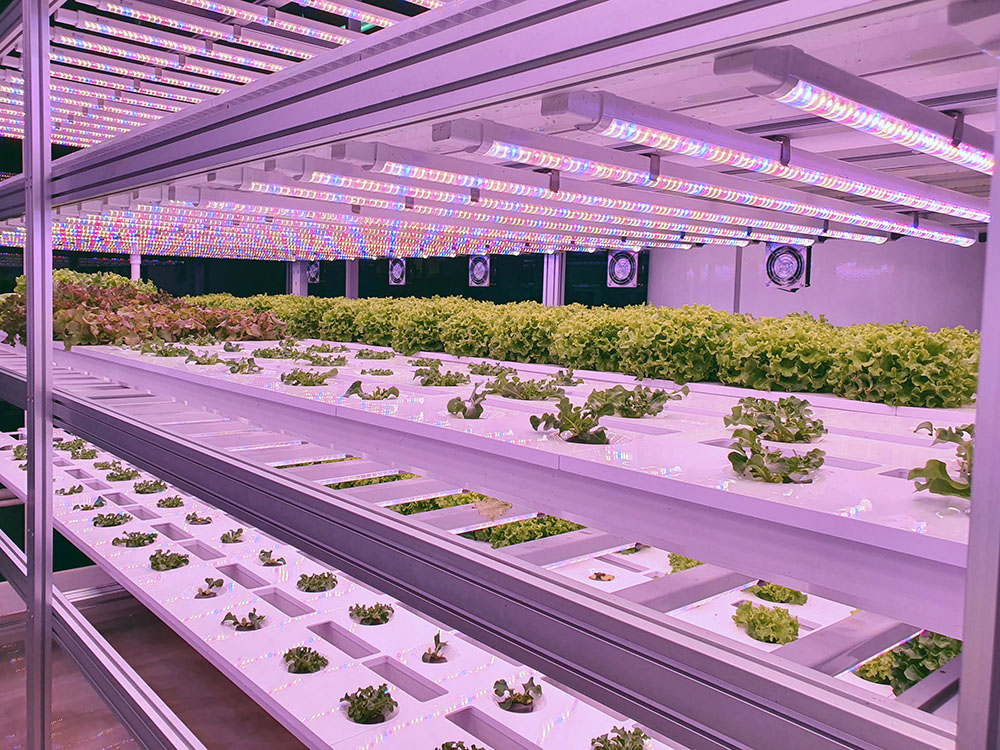
- hydroponic and controlled environment agriculture (CEA)
- data analytics and remote monitoring
- robotics and automation
Together, these technologies help growers make better decisions while using fewer resources, and they are becoming a standard part of commercial growing operations.
Why Does Agritech Matter Now?
Several converging trends are increasing demand for agritech. The average age of American farmers continues to rise, while fewer younger generations are entering traditional agriculture. At the same time, population growth and urbanization are increasing demand for fresh, locally grown food, and climate volatility, including droughts and unpredictable weather, is making conventional growing methods harder to rely on consistently.
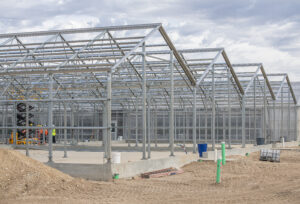
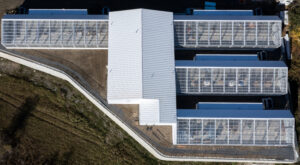
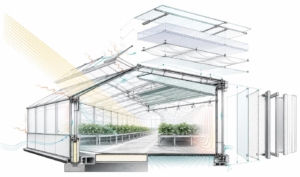
Agritech offers tools to adapt. By creating more controlled growing environments, growers can reduce dependence on unpredictable outdoor conditions while improving consistency and efficiency. Commercial greenhouses are one example: they bridge traditional farming and advanced environmental control, allowing growers to extend seasons, improve crop quality, and reduce resource consumption.
Why Does the Growing Environment Matter More Than the Technology?
Software, AI, and automation often dominate conversations about agritech, but the growing environment itself is the foundation those technologies depend on. A poorly designed environment limits how effectively any of them can perform.
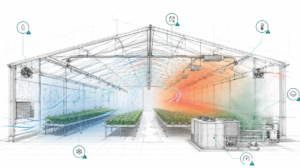
Airflow, humidity control, thermal management, and irrigation design determine the conditions technology has to work with. Efficient greenhouse systems create the baseline those tools improve on.
For example, integrating systems like the GAHT® (Ground to Air Heat Transfer) system allows growers to stabilize greenhouse temperatures using the earth itself as thermal storage. By reducing temperature swings and lowering energy demand, this creates a more efficient and resilient growing environment.
Climate control systems, such as the SunSense™ Controller, help growers coordinate temperature, humidity, airflow, and ventilation in a single system rather than as separate variables.
How Is Data Changing the Way We Grow?
Data-driven growing is changing how greenhouse operators manage their facilities. Environmental sensors and data systems can now monitor:
- temperature
- humidity
- CO₂ levels
- soil moisture
- light intensity
- irrigation performance
- plant health indicators
This information allows growers to move beyond reactive management and toward predictive decision-making: instead of waiting for stress symptoms to appear, they can identify trends early and adjust conditions proactively.
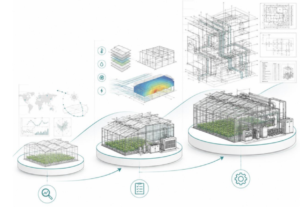
At Ceres, this systems-based approach is supported through Grow & Data Support services that help operators analyze environmental performance and optimize greenhouse operations over time.
How Does Agritech Support Sustainable Agriculture?
Agritech is also changing how sustainability is approached in agriculture. Traditional agriculture relies heavily on transportation, water, fertilizer inputs, and fossil fuels. Controlled environment agriculture can reduce many of these demands while growing food closer to consumers.
Greenhouses can:
- reduce food miles
- improve water efficiency
- lower pesticide use
- extend local growing seasons
- reduce land pressure
- increase production consistency
Passive solar design, thermal storage, efficient ETFE glazing, and automated environmental controls work together to reduce a greenhouse’s energy consumption compared to conventional indoor growing systems that rely entirely on artificial lighting and mechanical climate control.
Is More Technology Always Better?
More technology does not automatically produce better agriculture. Successful agritech is not about adding complexity for its own sake; it supports growers rather than replacing sound agricultural principles.
The most effective systems simplify operations, improve efficiency, and create healthier growing conditions without adding unnecessary complexity. Sensors still depend on an understanding of plant physiology, automation still requires thoughtful system design, and environmental control still depends on balancing biology with engineering.
Has Agritech Investment Slowed Down?
Venture funding for agtech and food-tech companies has fallen sharply from its 2021 peak. At least 21 agtech-related companies, concentrated in vertical farming, insect farming, and alternative protein, filed for bankruptcy or liquidation in 2025, tied to more than $2.8 billion in disclosed venture capital. High-profile vertical farming closures included Plenty Unlimited, which had raised $940 million, and Bowery Farming, which had raised $700 million before shutting down in late 2024.
Most of these failures followed a similar pattern: companies built large, capital-intensive facilities before securing buyers or proving unit economics, then depended on continued fundraising to cover the gap. When venture capital pulled back sector-wide, starting around 2022, companies that hadn’t reached profitability had no way to bridge the shortfall, and total agrifoodtech funding fell roughly 70% from its peak.
This contraction is concentrated in venture-backed vertical farming and adjacent categories, not in controlled environment agriculture as a whole. The broader CEA market, which includes traditional and hybrid greenhouse operations, is still projected to grow from roughly $90 billion in 2026 to $143 billion by 2031, driven by water scarcity, climate variability, and demand for local, year-round food production.
Where Is Agritech Headed?
Climate volatility, including drought, extreme heat, and unpredictable weather, is adding structural pressure to conventional outdoor agriculture, which strengthens the case for growing methods that are less exposed to weather variability. Controlled environment agriculture, including greenhouses, is one part of that diversification, though researchers caution it isn’t a universal or automatic food-security solution on its own and depends on sound economics, energy planning, and realistic scale.
The next phase of agritech is likely to look different from the funding boom of the early 2020s: fewer speculative, venture-driven builds, and more facilities designed around confirmed demand, energy efficiency, and realistic timelines.
Growth areas already include:
- urban agriculture
- rooftop farming
- greenhouse automation
- AI-assisted cultivation
- renewable energy integration
- precision irrigation systems
Agritech reflects agriculture as a continually evolving system, adapting to environmental, economic, and societal change. Greenhouses illustrate this directly: they combine natural sunlight with precise environmental control, merging traditional agriculture with modern technology to support both productivity and sustainability.
Bringing Agriculture and Technology Together
Agritech is about creating smarter growing systems: using technology intentionally to improve efficiency, reduce waste, support growers, and produce healthier food more sustainably. Greenhouses and controlled environment systems combine traditional growing principles with modern technology, which is why they play a central role in how agritech is applied today.
See how these principles come together in practice in Ceres’ case studies.