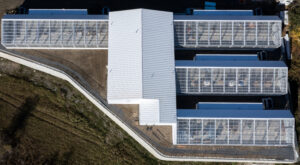
With drought conditions affecting more and more growing regions worldwide, water efficiency has moved from a best practice to a business necessity. For growers evaluating their options, one question comes up repeatedly: Do greenhouses actually save water, or does the added infrastructure just shift where the water goes?
They do!
Across a wide range of crops and climates, greenhouse production has been shown to use a fraction of the water required for outdoor growing — a gap that widens considerably as irrigation technology improves.
Why Greenhouses Use Less Water Than Outdoor Growing
Water loss in outdoor growing is driven by several forces that a greenhouse — even a vented one — significantly reduces or eliminates.
Wind is one of the biggest culprits in outdoor crop water loss. It accelerates evapotranspiration across the crop canopy, pulling moisture from leaves and soil at a rate that’s difficult to compensate for. Even a well-vented greenhouse dramatically cuts wind speed at the canopy level, reducing this loss substantially.
Rainfall is unpredictable. Outdoor growers are at the mercy of inconsistent precipitation, which leads to either deficit stress or oversaturation. In a greenhouse, irrigation is precisely controlled, applying water when the crop needs it and nowhere else.
Soil evaporation drops significantly in an enclosed environment. Without direct sun exposure and wind moving across open ground, the soil surface retains moisture far longer than it would outdoors.
Humidity retention slows plant transpiration. Greenhouses maintain higher ambient humidity than the open air, which reduces the vapor pressure deficit — the atmospheric “pull” that draws moisture out of plants. The result is a crop that loses less water through its leaves simply because the surrounding air is less aggressively dry.
Does Venting a Greenhouse Reduce Its Water Efficiency?
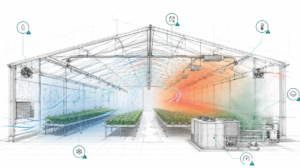
It does. Venting introduces air exchange, which allows some humidity to escape and modestly increases plant transpiration compared to a sealed environment. But even a fully vented greenhouse retains more humidity than outdoor conditions, and the protection from wind and direct weather exposure remains intact. The water efficiency advantage of a vented greenhouse largely holds when compared to outdoor production.
Modern Greenhouse Irrigation: Where the Real Water Savings are Made
The greenhouse structure itself creates the conditions for efficiency, but it’s the irrigation technology inside that determines just how little water a crop actually needs.
Drip irrigation delivers water directly to the root zone, eliminating the surface evaporation and runoff associated with flood or furrow systems. In a greenhouse setting, drip systems can be fine-tuned to match crop demand at different growth stages, significantly reducing waste.
Substrate and soilless growing take this further. When crops are grown in controlled media (i.e., rockwool, coco coir, perlite, etc.), irrigation volumes can be dialed in with precision. There is no large soil mass absorbing and losing water unpredictably.
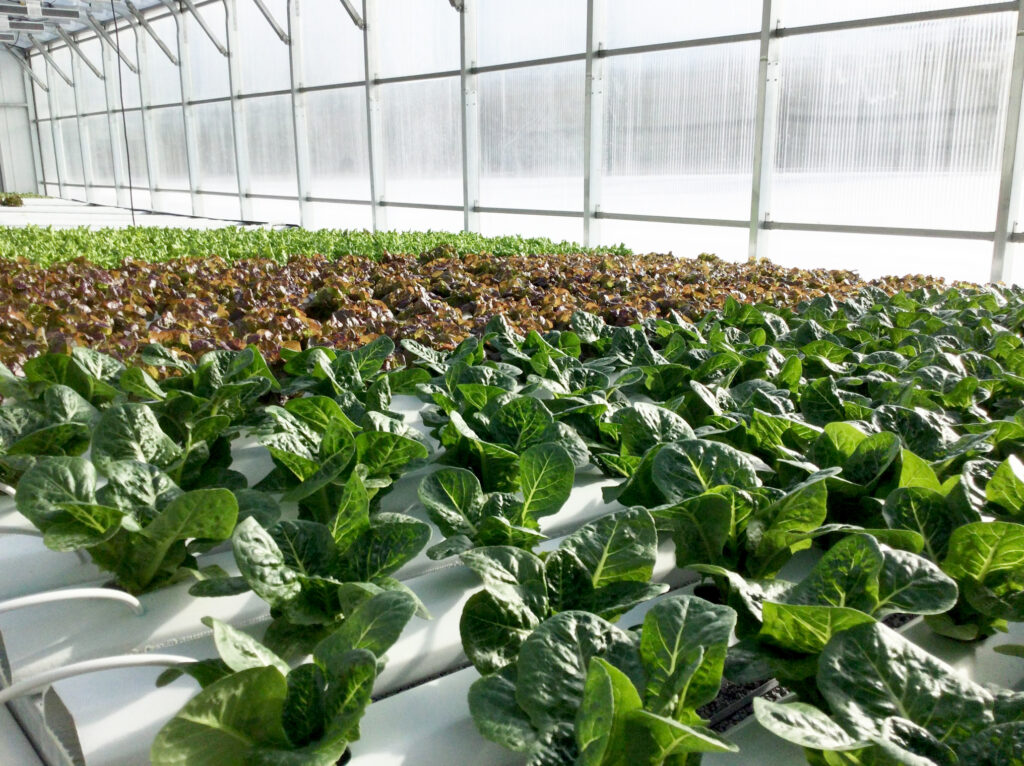
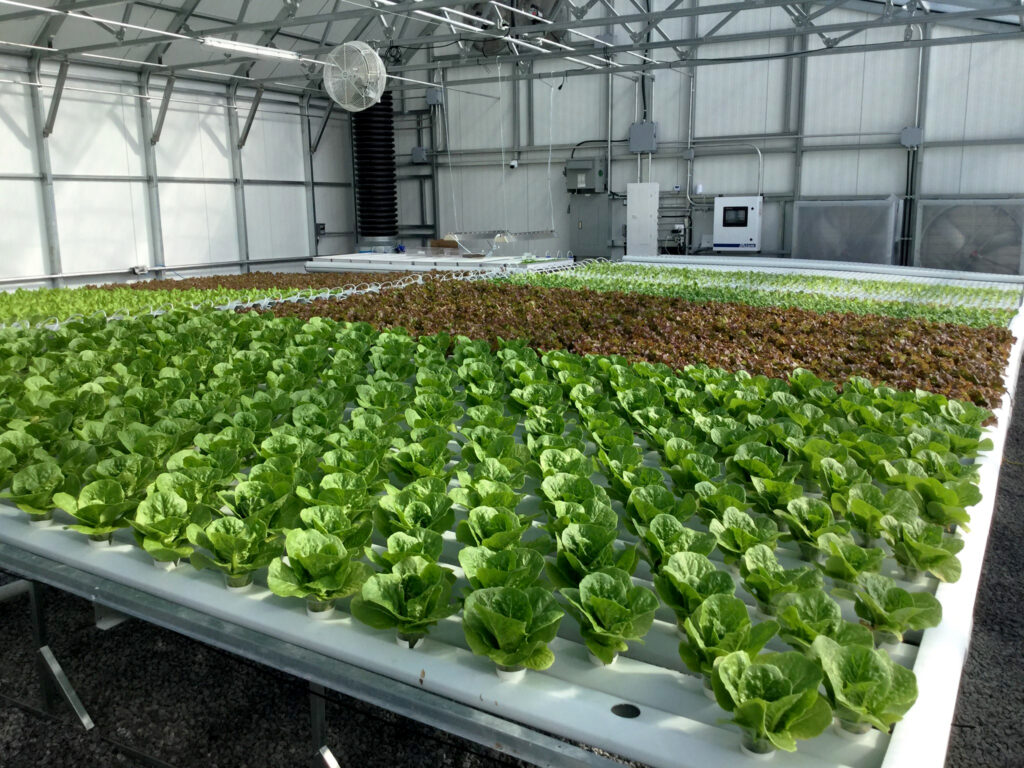
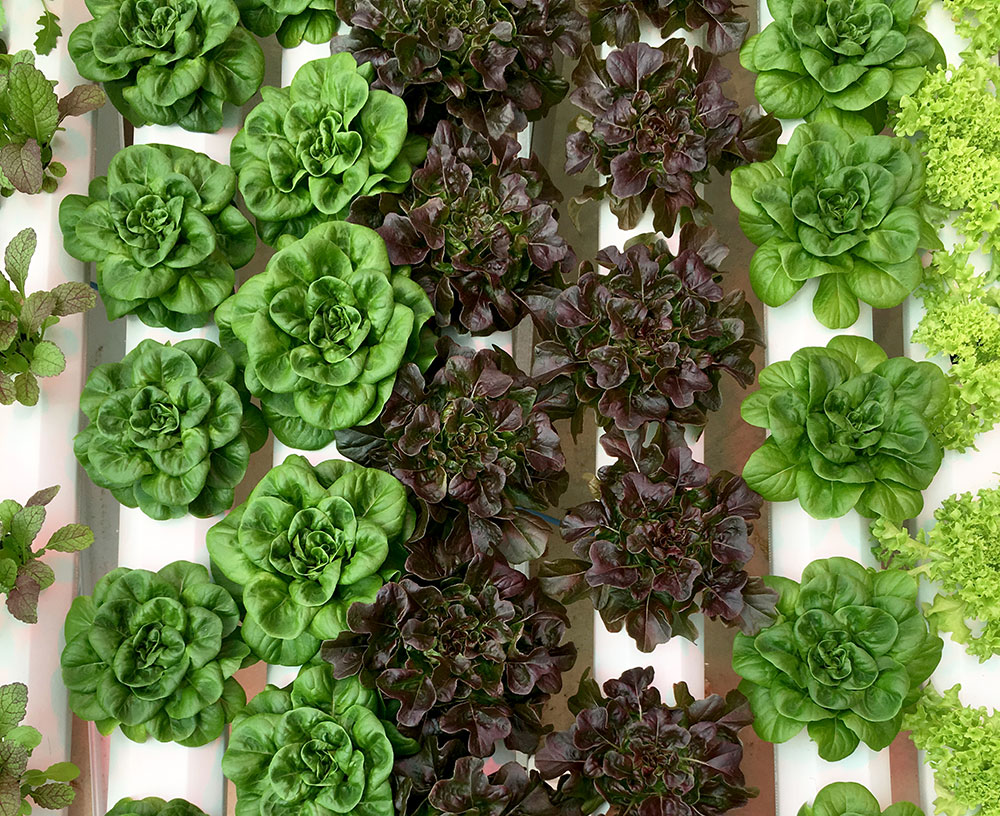
Hydroponic systems eliminate soil entirely, delivering nutrient-rich water directly to plant roots in a controlled, recirculating environment. Because water and nutrients are continuously cycled through the system rather than applied and lost, hydroponics dramatically reduces overall water consumption compared to both outdoor and soil-based greenhouse growing. At commercial scale, recirculating hydroponic systems are among the most water-efficient production methods available — and they offer the added advantage of faster growth rates, higher yields per square foot, and greater consistency, making them particularly well suited to large-scale operations.
Aeroponic systems take water efficiency even further. Rather than submerging or flooding roots in a nutrient solution, aeroponics delivers water and nutrients as a fine mist directly to suspended plant roots. Because roots are exposed to air between misting cycles, plants absorb what they need with minimal waste and no standing water. Studies have shown that aeroponic systems can use up to 95 percent less water than conventional soil-based growing, while also accelerating growth and improving nutrient uptake. Though more technically complex and capital-intensive than hydroponics, aeroponics is gaining traction in commercial and research greenhouse settings where maximum efficiency and precision are priorities.
Sensor-driven irrigation control is an increasingly viable approach in commercial greenhouse operations. Research has demonstrated that substrate moisture sensor-based feedback control irrigation systems can be effectively applied across greenhouse crop production, maintaining crop growth and quality even under varying microclimatic conditions. By monitoring substrate moisture in real time, growers can move away from fixed irrigation schedules and toward demand-driven water management — delivering water based on what the crop actually needs, when it needs it, rather than on a predetermined timer.
Drainage recirculation closes the loop entirely. In recirculating systems, excess nutrient solution that drains from the growing medium is captured, treated if necessary, and reintroduced into the irrigation cycle. Very little water leaves the system as waste.
Sealed Greenhouses: The Most Water-Efficient Growing Environment Available
A fully sealed or closed greenhouse — one that minimizes or eliminates air exchange with the outside environment — represents the most water-efficient growing environment currently achievable at commercial scale.
In a sealed system, humidity released by plant transpiration is retained within the structure rather than vented outside. That moisture can be captured through dehumidification systems and returned directly to the irrigation supply, effectively recycling the water that plants themselves release.
Research has shown that closed recirculating greenhouse systems can achieve up to 40 percent in daily water savings compared to open greenhouse systems — a meaningful gain on top of the already significant efficiency advantages greenhouses hold over outdoor production.
Sealed environments also allow for precise atmospheric control, meaning growers can maintain the vapor pressure deficit at levels that optimize growth without driving unnecessary transpiration. The crop uses water more efficiently at the plant level, not just the system level.
Greenhouse vs. Outdoor Growing: Water Use Comparison
| Growing Method | Relative Water Use |
| Outdoor flood/furrow irrigation | Baseline (highest) |
| Outdoor drip irrigation | ~50% of baseline |
| Vented greenhouse, soil beds | ~35%-45% of baseline |
| Vented greenhouse, drip irrigation | ~25%-35% of baseline |
| Closed greenhouse, hydroponics | ~10-20% of baseline |
Sources: Food and Agriculture Organization of the United Nations (FAO); International Water Management Institute (IWMI). Figures represent ranges drawn from across the literature. Water use varies by crop, climate, and management practice.
Where Greenhouses Can Use More Water: Important Caveats
Greenhouses are not automatically water-efficient — they create the conditions for efficiency, but those conditions must be actively managed.
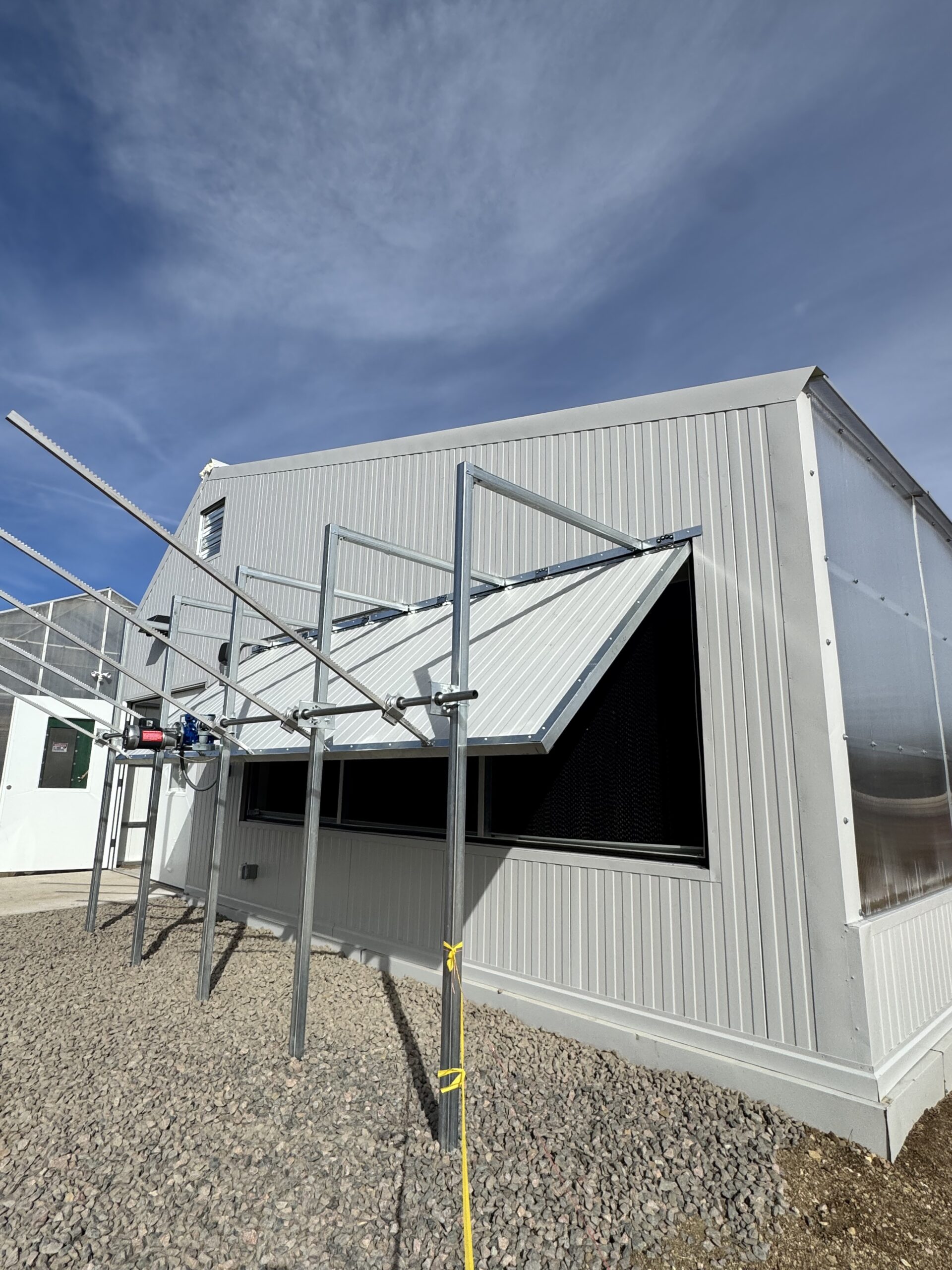
In hot climates, evaporative cooling systems and fogging setups used for temperature and humidity management add water consumption that can offset some of the gains. Growers in arid, high-temperature environments need to account for this in their water budgeting. Additionally, soil-based greenhouse growing without drip irrigation can lead to overwatering, particularly for less experienced operators, since the absence of rainfall cues can make irrigation timing less intuitive.
The efficiency gains are real, but they are realized through intentional system design — not simply by putting a structure over a crop.
The Bottom Line: Greenhouses Are a Direct Response to Water Scarcity
For growers navigating drought conditions, water restrictions, or simply the pressure to produce more with less, the greenhouse model offers a compelling and data-supported case. A vented greenhouse with drip irrigation is already a significant step forward in water efficiency compared to outdoor production. Add recirculating hydroponics or move toward a sealed environment, and the numbers become transformational.
In a world where water is increasingly scarce and increasingly expensive, the question may no longer be whether you can afford to grow in a greenhouse — but whether you can afford not to.
Contact us to learn more.