For many greenhouse projects, the glazing decision eventually narrows to a familiar comparison:
Polycarbonate or something newer like ETFE?
Polycarbonate has become a common choice over the past few decades. It’s lighter than glass, relatively durable, and widely available. For many growers, it represents a practical, well-understood option.
ETFE, by contrast, is less familiar in greenhouse applications, particularly in North America. It’s often introduced later in the process, usually when the conversation shifts toward long-term performance or system efficiency.
At that point, the question becomes less about what works on day one and more about how each material behaves over time.
When comparing ETFE vs polycarbonate greenhouse glazing, the differences are often subtle at first, but become more significant over time.
Starting From the Same Goal
Both polycarbonate and ETFE are used for the same reason: to create a controlled environment where light, temperature, and humidity can be managed in support of plant growth.
They both allow light into the structure. They both provide protection from external conditions. And both can be integrated into greenhouse systems with varying levels of sophistication.
Where they begin to diverge is not in what they do, but in how consistently they do it.
Light Transmission and What Changes Over Time
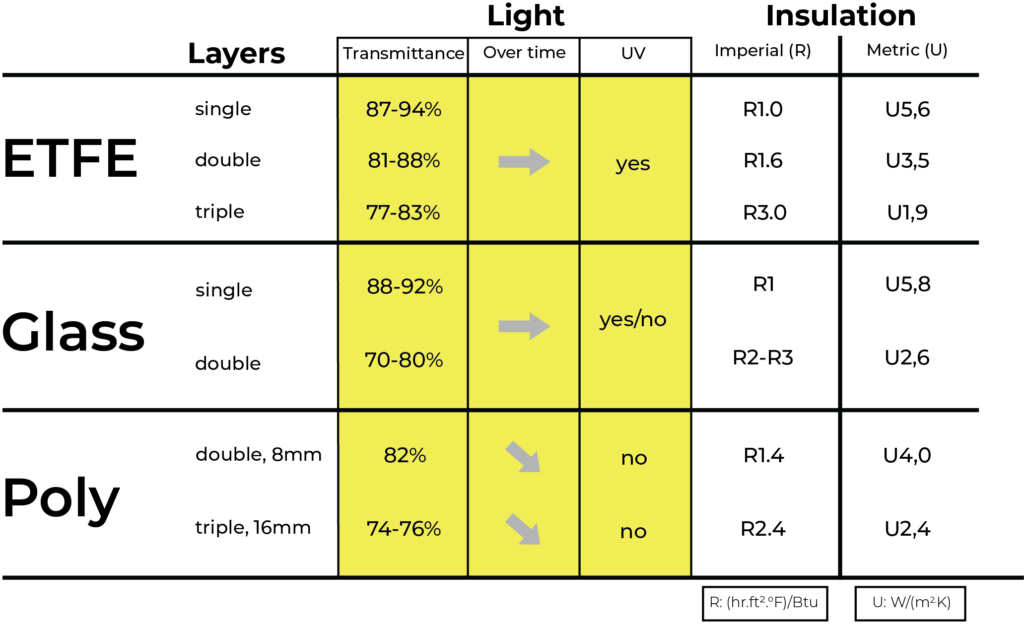
Early in a greenhouse’s life, polycarbonate performs well. It transmits a useful level of light and provides some diffusion, which can help reduce harsh shadows.
Over time, however, polycarbonate tends to change. Exposure to UV radiation and environmental conditions can lead to gradual yellowing or loss of clarity. These changes are often subtle at first, but they affect how much usable light reaches the canopy.
ETFE behaves differently in this regard. It maintains a higher level of light transmission over longer periods, including a broader portion of the UV spectrum. For growers, this can influence plant morphology, coloration, and overall consistency across the growing space.
The difference is not always dramatic in the short term. It becomes more noticeable across multiple growing cycles.
Structural Weight and Design Flexibility
One of the defining characteristics of polycarbonate is that it is lighter than glass, which makes it easier to work with structurally.
ETFE extends that advantage further. Because it is significantly lighter, it reduces structural load and allows for more flexibility in how a greenhouse is designed, particularly in larger-span structures.
In commercial greenhouse applications, this can influence:
- Structural material requirements
- Installation complexity
- Overall design possibilities
In retrofit scenarios, weight becomes even more relevant. Existing structures often have limits on what they can support. In these cases, lighter materials can expand what is feasible without requiring major structural changes.
Durability in Greenhouse Conditions
Both materials are designed to operate in challenging environments, but they respond differently over time.
Polycarbonate is impact-resistant and performs well initially. However, it is more susceptible to long-term degradation from UV exposure and environmental wear.
ETFE is highly resistant to UV degradation and maintains its properties across a wider range of temperatures and conditions.
This includes resistance to:
- Prolonged UV exposure
- Temperature extremes
- Hail, wind, and fire
- Many chemicals used in greenhouse operations
As a result, ETFE tends to maintain its performance more consistently over longer periods.
Maintenance and Operational Stability
Maintenance is often evaluated in terms of cost, but it also affects how stable the growing environment remains.
Polycarbonate surfaces can accumulate dirt and debris over time, requiring periodic cleaning to maintain light transmission.
ETFE’s surface is naturally non-stick, which reduces the tendency for buildup. In many environments, rainfall is sufficient to remove accumulated debris.
The practical difference is not the elimination of maintenance, but a change in how often it is required and how much performance fluctuates between cleaning cycles.
A Difference in Time Horizon
Many of the differences between polycarbonate and ETFE are not immediately visible, but emerge over time.
Polycarbonate can be a practical solution for projects where:
- Lower upfront cost is a priority
- Short- to mid-term performance is sufficient
- Replacement cycles are part of the plan
ETFE tends to align with projects where:
- Long-term consistency is important
- Maintenance needs to be minimized
- Structural efficiency matters
- The greenhouse is part of a larger, integrated system
- Fires might be a threat
This includes many commercial greenhouse builds and research-based projects, where performance is evaluated over decades rather than years.
Polycarbonate may be appropriate where upfront cost is the primary constraint.
ETFE tends to align with projects prioritizing long-term performance and system integration.👉Check out our video comparing ETFE to Polycarbonate light transmission
Putting the Comparison in Context
It’s tempting to frame this as a choice between two materials, but in practice, it’s more useful to think of it as a choice between different approaches to performance.
Polycarbonate reflects a well-established, widely used solution with known trade-offs, while ETFE represents a newer approach, particularly over longer timeframes.
For an overview of glazing materials in general:
For a broader look at how ETFE fits into greenhouse systems:
👉 ETFE Greenhouse Glazing: A Different Way to Think About Greenhouse Materials
To see how ETFE is implemented in greenhouse systems:
The decision between polycarbonate and ETFE is not just about materials. It’s about how you expect the greenhouse to perform over time, across changing conditions, and within the context of the systems that support it.