Client: KWS
Location: Einbeck, Germany
Partners: Ceres, Block
Ceres Involvement: Consulting
Date: February 2026
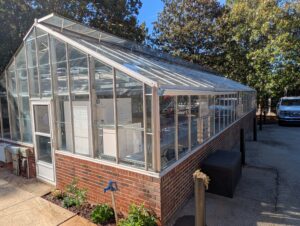
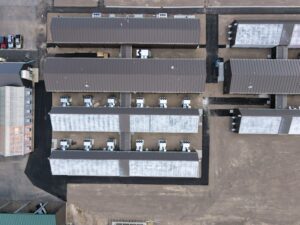
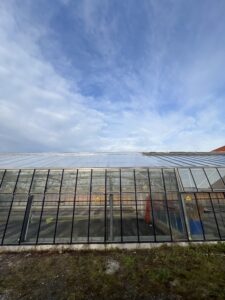
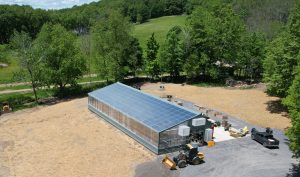
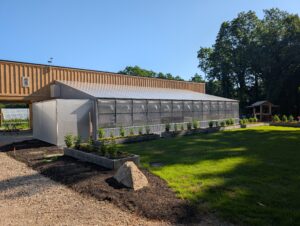
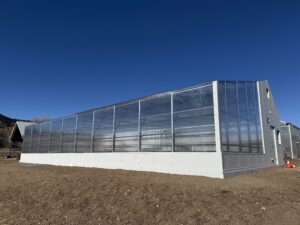
KWS enlisted the help of Ceres Greenhouse Solutions after dealing with falling glass in one of their greenhouses located at their headquarters in Einbeck, Germany. Ceres, in partnership with Block, installed ETFE film glazing as a lighter, stronger, and longer-lasting solution to the aging glass. The result is not only a safer working environment but also a more productive one, since ETFE allows more light to enter the growing space.
The Challenge
For KWS, one of the world’s leading plant breeding companies, greenhouse safety is non-negotiable. But in several of their older glasshouses in Einbeck, Germany, extreme weather events had begun taking a toll. Storms repeatedly cracked glass panes, and in rare but serious cases, entire panes shattered and fell, sometimes in large fragments, directly into growing and working areas.
The risk wasn’t theoretical. Falling glass posed a genuine safety hazard to the employees who worked beneath it every day, and the team at KWS knew the issue needed a permanent fix.
Their first instinct was a common one: install a safety net beneath the glass roof to catch falling debris. But nets bring their own tradeoff. A net dense enough to catch broken glass would also block meaningful light from reaching the crop below, a loss that, especially in Einbeck’s darker winter months, would have to be offset with additional supplemental lighting. For a facility built around precision growing conditions, that tradeoff was hard to accept.
“A net would have caused significant shading in the greenhouse. The resulting loss of light — especially during the darker months — would have needed to be compensated by energy-intensive supplemental lighting. For these reasons, we decided against this option.”
— Isabell Blumenberg, Head of Einbeck Greenhouse Facility
The Ceres Solution
Rather than trap the risk, Ceres proposed removing it. Working with longtime ETFE partner Block, Ceres recommended replacing the damaged glass panes — in the greenhouse’s most critical, highest-risk areas — with ETFE film glazing instead of installing a net or simply replacing the glass in kind.
ETFE offered a rare combination of advantages that made it the clear choice over a like-for-like glass replacement:
• Stronger and far less prone to shattering than glass
• Longer-lasting, reducing the likelihood of repeat replacement
• Safer for employees working underneath it
• Higher light transmission, including UV, benefiting the crop
The two teams then had to solve a practical installation challenge: how to fit ETFE onto a structure engineered for glass. Ceres collaborated directly with Block to design a custom bracket that allowed the ETFE to be installed seamlessly on top of the existing glass tracks — avoiding a costly structural overhaul and keeping installation straightforward.
Why Ceres and Block
KWS’s relationship with Ceres predates this project, and that history mattered. At the same time, KWS was already breaking ground on new greenhouses at other locations built with ETFE from the start, which raised a natural question: could the same material solve a problem in an existing facility?
Ceres helped connect KWS with Block’s local team, giving KWS the opportunity to visit an existing ETFE greenhouse in the region and see the material in person before committing. That firsthand look, paired with direct conversations with the Block team, gave KWS the confidence to move forward.
“We were able to establish local contact with Block via Ceres, allowing us to visit an existing ETFE greenhouse within our region. These insights, as well as the direct exchange, further supported our decision.”
— Isabell Blumenberg, Head of Einbeck Greenhouse Facility
The Results
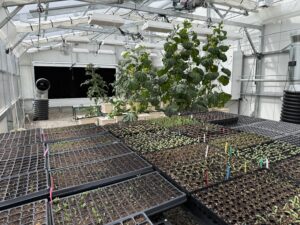
Since the retrofit, KWS reports that the greenhouse performs and grows just as well as it did under glass, with a few notable differences. The space now appears brighter, and it warms more quickly in direct sunlight. On the flip side, it also loses heat faster once the sun goes down, which has meant adjusting heating schedules to start slightly earlier or run a bit more intensively than before.
Most importantly, the core problem is solved: the safety hazard that started this project is gone, without the light-blocking tradeoff a net would have required.

Looking Ahead
The success of the Einbeck retrofit has given KWS confidence to expand the approach. The company is now converting additional greenhouse roof areas to ETFE foil across their facilities, extending the usable life of older glasshouses that would otherwise face the same aging risks.
“By installing ETFE, we have extended the usability of our older greenhouse facilities and are currently converting additional greenhouses to ETFE foil in the roof area.”
— Isabell Blumenberg, Head of Einbeck Greenhouse Facility
Have an aging glass structure creating a safety risk you’d rather solve than patch? Contact Ceres today!
About KWS
KWS is one of the world’s leading plant breeding companies. Around 5,000 employees* in over 70 countries generated net sales of around €1.68 billion in fiscal year 2024/2025. A company with a tradition of family ownership, KWS has operated independently for 170 years. It focuses on plant breeding and the production and sale of seed for sugarbeet, corn, cereals, vegetables, oilseed rape and sunflowers. KWS uses leading-edge plant breeding methods to continuously improve yield for farmers and plants’ resistance to diseases, pests and abiotic stress. To that end, the company invested approximately €350 million in fiscal year 2024/2025 in research and development.