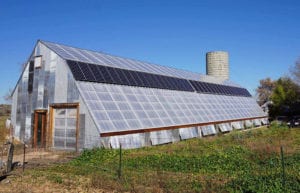
Pests can affect greenhouses a little differently than the outdoor garden, particularly year-round insulated greenhouses that are warmer and more humid. The top three pests we’ve encountered in our years of greenhouse growing are aphids, fungus gnats, and white flies. Of course, it is not an exhaustive list –you may encounter many more in your experience — but these three are by far the most common in residential year-round greenhouses. We always recommend natural strategies first, like prevention and beneficial insects in managing these common insects; however, we’ll also discuss some natural sprays below.
Aphids
Quick facts:
- Reproduce prolifically and very quickly
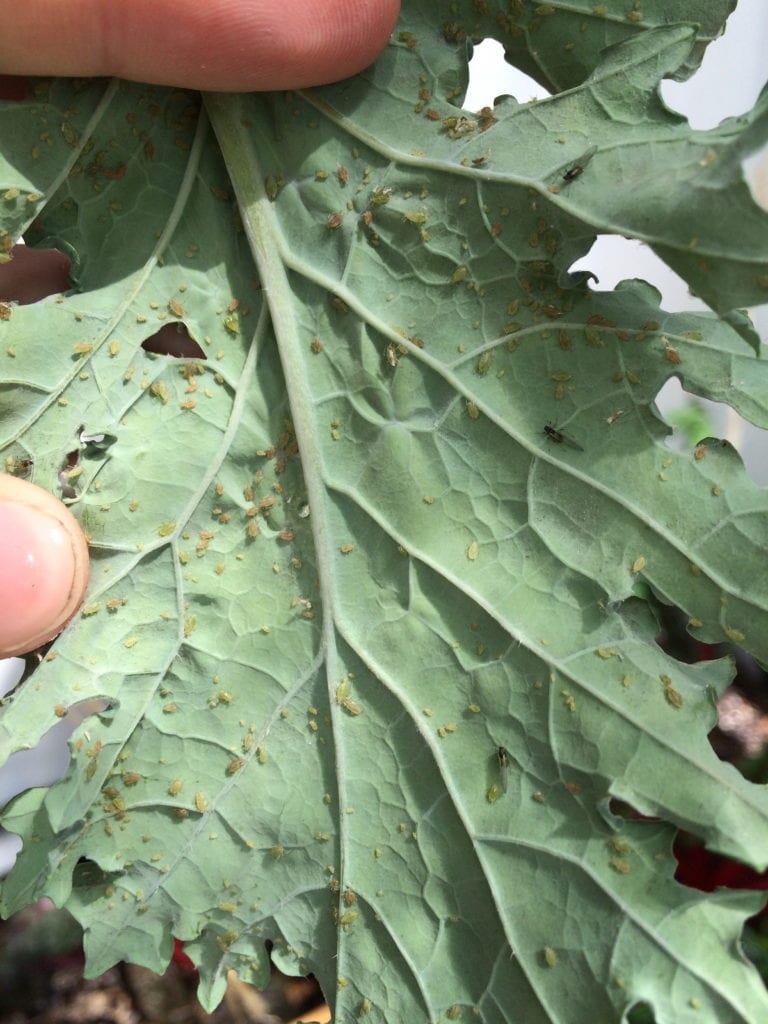
- Easily spotted as oval gold shapes on the underside of leaves
Aphids are usually the number one insect problem in greenhouses. You can easily identify them as gold oval shapes, usually in clusters, on the underside of leaves. The thing to understand with aphids is how quickly the population can take off: Reproduction occurs without actually mating, and only females are produced. Females reproduce within a week, creating 3-10 offspring per day, which again start to reproduce prolifically within a week. In short, aphids can go from a small problem to a big problem very fast.
Tips and tricks for dealing with aphids.
It sounds a bit cliché, but the easiest solution to aphids is to catch the problem early, before it takes over. It’s important to regularly look under leaves and be attentive to your greenhouse. If a population gets hold while you’re on a three-week vacation, it could very easily destroy your plants.
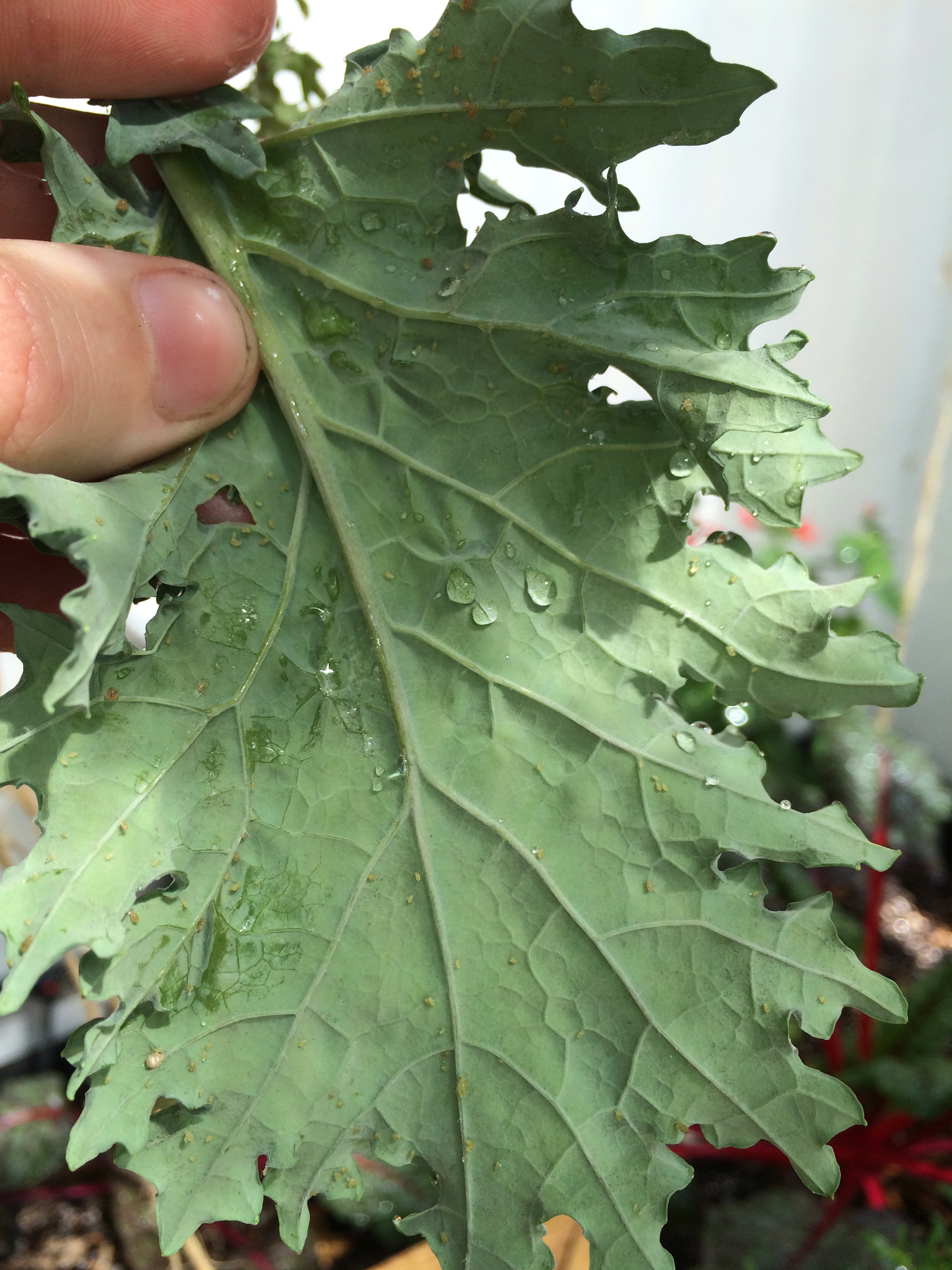
If aphids do establish in your greenhouse, we’ve found one of the most effective techniques for removing them is the simplest: water. You can simply wash these leaf dwellers off with a hose or spray bottle. This disturbs them enough, so they do not establish or stick around. The downside here is it requires a good eye and some time: aphids will reside on the shady underside of leaves, so you have to turn leaves over and gently spray each leaf. Again, a hose on a gentle spray works for larger areas; a spray bottle works for targeted areas or leaves heavily populated. You want to make sure you keep a gentle spray so you don’t bruise the leaf too much in this process. You can see the before and after effect of washing off a kale leaf to the right.
Some leaves may be beyond rescue, in which case, remove these if it won’t severely damage the plant. We recommend washing off leaves once every other day, until you see pest populations severely diminish. Below you can see aphids on a kale leaf, and the same leaf after it has been washed off.
Also keep in mind that aphids can persist through the winter, and in many cases they’ll produce wings and migrate to other parts of your garden… all part of the fun in keeping these pests at bay.
In combination with washing aphids off, you can also use beneficial insects – ladybugs and lacewings – to combat the problem. Usually, naturally occurring concentrations of ladybugs are not enough to combat a full aphid outbreak, but they can be a great supplementary defense and a protective measure to keep aphids at bay over the long term. You can attract them to your greenhouse (if it is kept open) by planting pollinating flowers which they eat in addition to insects.
For larger outbreaks, you can also purchase ladybugs or lacewings at a garden store or online. We will go into more tips for using beneficial insects in your greenhouse in our next blog.
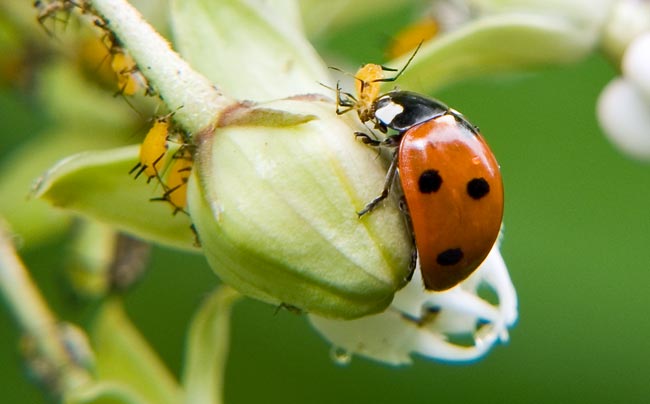
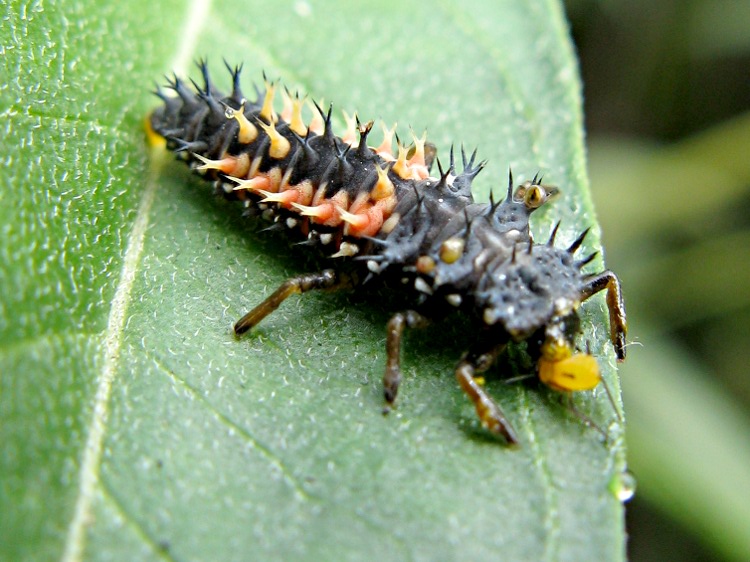
In all our strategies, a very important tool is identifying what you’re seeing, so you can find the right control measure and don’t accidentally kill a beneficial insect. For instance, young ladybugs actually look like tiny alligators (shown below), and could easily be confused for a harmful insect. However, these maturing ladybugs actually consume many more aphids than the adults, so make sure you keep them around.
Gnats
Quick facts:
- Lay eggs in the top layer of soil if the soil is wet
- Combated by reducing moisture on the soil, or using sticky traps
The second major problem insect is fungus gnats. These lay eggs and pupate in the top layer of soil. When they hatch, they develop wings, turning into annoying flies that look much like your household fruit fly (though gnats are a slightly different variety). People are often familiar with these as they are usually common with house plants. They feed off dead plant tissue and also leaves, particularly seedlings.
Because they’re soil dwellers, the best strategies for controlling gnats are covering the top layer of wet soil with something that they can’t hatch in, like pebbles. We also like to use self-watering planters, like Farm Tub’s, which water roots from a reservoir at the bottom of the planter, allowing the topsoil to stay dry.
With flying insects like gnats, you can also hang sticky traps to catch them. I find that when a population really emerges, they tend to collect on windows and sills. You can wipe out a large number just by spraying them off with a window cleaner, or using a vacuum to suck up hundreds or thousands at a time. As with all pests, you want to use a combination of controls, like a vacuum and sticky traps, to knock the population out over time. There are parasitic mites and nematodes that will eat fungus gnats, but ordering those as specialty items is usually above and beyond what most gardeners want to do.
Whiteflies
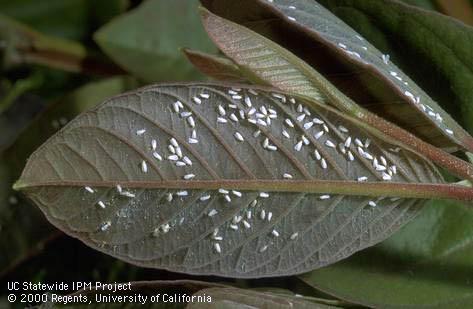
It’s a little harder to give the prize for the third most problematic greenhouse pest, since beyond aphids and gnats, several can be a problem, though not as severe. In our years of experience with year-round greenhouses at Ceres, whiteflies probably come up as the next biggest issue. These are similar to gnats, though white, and can also be combatted using sticky traps.
We’ve also commonly seen rolly polly (pill bugs), which emerge on wet soil and can also eat seedlings. Greenhouses, particularly energy-efficient greenhouses, trap moisture more easily. That’s nice as it reduces the watering requirement, but can often lead to wet soil. Thus, we recommend being careful not to overwater the greenhouse. This is another nice time to use a self-watering planter, like Farm Tubs or another design, to keep the soil surface dry, while still allowing the plant roots to access water in the reservoir.
Natural sprays
If the above methods are not getting the job done, there are also some more earth-friendly insecticidal sprays. These typically use pyrethrum – a naturally occurring plant chemical (made from chrysanthemums) that is toxic to insects. The advantage of sprays is that you have a much higher effectiveness at killing pests compared to just washing bugs off. Pyrethrum or other natural insecticides will kill adults, larvae, and eggs. The disadvantage is that they are expensive and require just as much time to use as simple water washing. Greenhouses using aquaponics should be careful about which sprays to use: pyrethrum can be harmful to fish.
Pest Prevention
There are different mantras on how to reduce the number of pests that get into your greenhouse in the first place. Some people take the ‘controlled environment’ approach, preventing bad bugs from getting into the greenhouse by controlling what gets in. That means washing off any stars brought in, using screens on the windows and openings, not letting pets in, and even changing shoes at the door. This can make sense if you have a commercial greenhouse where an infestation can mean a big financial hit.
At Ceres, our attitude is a little different. Keeping the greenhouse completely controlled and shut off from the outdoor environment takes a lot of effort and is not always successful. We recommend taking the easy measures, like washing off the plants before they’re brought into the greenhouse. But sweating every move and everything that comes in, usually takes the fun out of growing. Even with those measures, we’ve found the bad bugs simply find their way in one way or another. Rather, we focus on creating a balanced, healthy ecosystem in the greenhouse that is capable of defending itself and recuperating quickly.
This means focusing on overall plant health and a greenhouse environment that mimics the best of outdoor conditions. Healthier plants are much better equipped to tolerate and defend against insects. Thus, ensuring your plants are healthy by maintaining good soil and nutrients, minimizing temperature shocks with proper energy-efficient greenhouse design, is the first defense against insects. During colder months, they are much more humid and do not have as much air movement since the greenhouse is usually closed (not ventilated). Stagnant humid air is a perfect home for breeding insects. A couple of tips to accommodate:
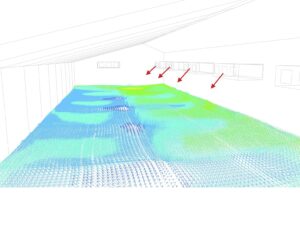
- Keep up air movement. This makes it much harder for pest populations to establish. It also strengthens plants if they are gently moving. We recommend a circulating fan positioned in a corner of the greenhouse, creating some circular air movement.
- Do not overwater. Too much humidity and wet topsoil increase insect breeding.