Key Takeaways
- What defines a commercial greenhouse and how size, location, and design affect profitability
- The benefits and challenges of commercial greenhouse production in 2026
- How energy, labor, and capital costs impact greenhouse investments
- A comparison of leafy greens and strawberries as leading greenhouse crops
- How market trends and controlled environment agriculture are shaping greenhouse ROI
With these factors in mind, the real question isn’t if commercial greenhouses can be profitable—but under what conditions they make sense as an investment in 2026.
What is a Commercial Greenhouse?
At Ceres, conversations about commercial greenhouse investing rarely start with a single, simple answer. That’s because “commercial greenhouse” can mean many things—from a 3,000-square-foot facility serving a local market to a hectare-scale operation designed for year-round production at scale. The range of sizes, layouts, and technology options is vast, and each configuration carries different implications for cost, risk, and return. In this article, we’ll explore whether a commercial greenhouse is a good investment in 2026, looking at both small and large cultivation facilities and how factors like location, market access, and production goals shape their viability.

How Greenhouse Size and Location Shape Viability
Usually, market demand and grower location dictate what size growing facility is appropriate for a specific project. Some of our commercial growers live in small, remote areas, where demand for local food is high. In these locations, 3,000 to 6,000 square feet of growing space can be more than enough to create a viable business.
In other markets, closer to large population centers, many of our clients look to grow 1 to 2 acres of greenhouse (45k to 90k square feet) or more to allow for economies of scale to reduce production costs, while being able to supply the larger market.
Benefits of Commercial Greenhouse Production
Key advantages include:
- Fresh, locally grown produce that reaches consumers the same day it’s harvested
- Reduced transportation costs and lower carbon footprint
- Climate control that protects crops from extreme and unpredictable weather
- Improved water efficiency, especially in water-constrained regions
- Year-round growing that increases yields per square foot
- Higher revenue potential and the ability to support a full-time workforce
- Optimized workflows that can reduce labor demands and improve working conditions
Challenges Growers and Investors Should Consider
Managing Capital Costs, Energy and Labor
While there are many benefits to commercial greenhouse CEA, there are some hurdles as well. In an ideal scenario, a new business or grower would be able to design a facility specifically for their growing needs, with grow systems designed for efficient propagation, production, packaging, etc. In addition to the growing system, selecting energy efficient HVAC systems is also important for long term efficiency and viability, but these decisions can also increase capital investment.
In the long run these design choices are worthwhile investments, but in the early stages of a new business these costs can add up. Initial capital investments can be an issue for some new businesses, but there are ways to minimize the burden as well. Finding the best blend of technology + labor is important, deferring upfront capital costs for ongoing operational expenses. For food production, there are many grants available for a wide range of items. Hiring a grant writer or researching available grants can greatly reduce the capital needed to get a new commercial greenhouse off the drawing table.

Additional Real-World Challenges:
- Energy Costs
Energy remains a major operating expense, especially for year-round greenhouse production. - Labor Requirements
Automation can reduce labor needs, but labor is still essential for greenhouse operations. - Market Competition
Greenhouse growers compete with large-scale producers, including field-grown lettuce from California and strawberries from California and Mexico, making differentiation critical.
Crop Selection: Where Most Greenhouse Investments are Focused
For most commercial greenhouse investors and operators that we talk to, crop selection typically narrows to leafy greens or soft fruits, predominantly strawberries. Both offer strong market demand, but they differ significantly in production complexity and risk.
Leafy Greens: A Proven Greenhouse Investment
Production Characteristics
Whether its head lettuce, baby lettuce, or herbs, leafy greens are a known product with clear benefits for growers. Because the final product is leaf and not fruit, they are much easier to grow with a very quick growth cycle (usually around 1 month).
Lettuce is in high demand almost everywhere, and has a fairly stable price in the market which allows for brisk sales and revenue production. Depending on the greenhouse location, some lettuce facilities need to shut down during the warmer summer monthsadjust what they are growing to a more heat resistant variety, or have some way to keep the greenhouse cool during the summer months.
Market Outlook and Pricing Trends
North America’s leafy greens market was valued at approximately $14.2 billion in 2024, representing a significant share of the $83.95 billion global market. The region is projected to grow at a 5.8% CAGR through 2033, driven by several key trends:
- Increased consumer focus on health and plant-based diets
- Growing demand for locally grown and sustainably produced food
- Strong interest in convenient, ready-to-eat leafy green products
Current market conditions have further strengthened the case for controlled environment production. Early 2025 saw one of the most challenging field-growing seasons on record, leading to reduced plantings and tight supply. As a result, lettuce prices surged, with iceberg lettuce reaching $40–$50 per case and romaine $30–$45 per case, highlighting the value of reliable greenhouse supply.
The Role of CEA and Greenhouse Technology in Market Growth
California and Arizona remain the primary production hubs, but there’s significant growth in controlled environment agriculture, including hydroponics, vertical farming, and greenhouse operations. Hydroponics revenue in North America is projected to rise from approximately $3.64 billion in 2024 to around $10.75 billion by 2033 Viemose DGS.

Strawberries: An Emerging Opportunity
Why Strawberries Are Gaining Momentum
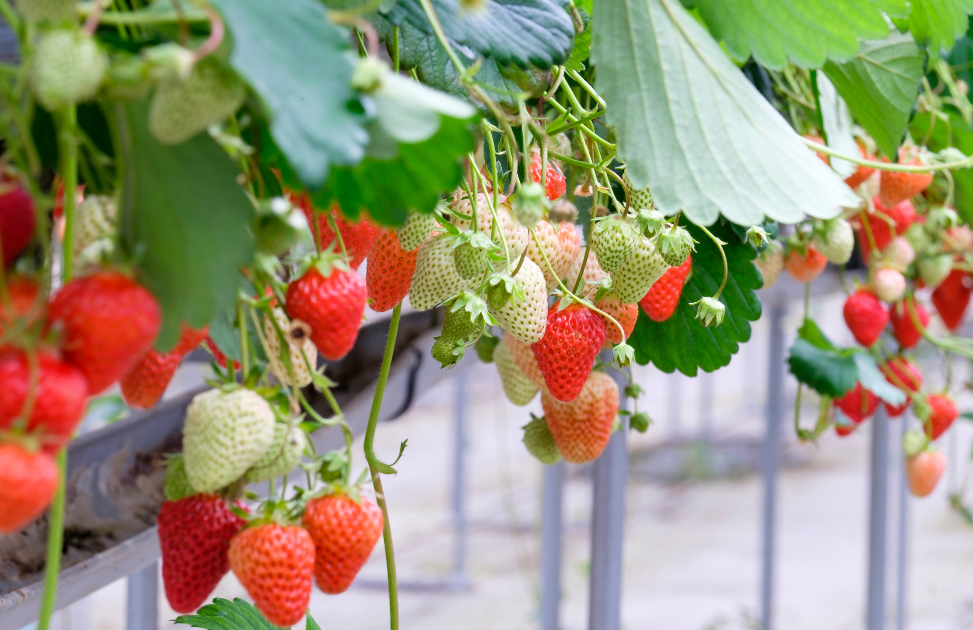
Strawberries in greenhouses are a somewhat new concept gaining popularity in the CEA space in North America, but there are still many unknowns about how this market segment will come to fruition. Strawberries are a common and highly desirable product for the average consumer, and there is a lot of room for a higher quality product on the market. Because strawberries are new to the CEA space at scale, there are many variables that need to be worked out, including genetics, SOPs (standard operating procedures), etc.
Strawberries are an ideal candidate for greenhouse production for many reasons. Store bought strawberries (as most Americans know them) are mass produced and shipped long distances, rendering them bland tasting and sometimes moldy in the package. Locally grown strawberries have the ability to ripen on the plant and be in the store the same (or following) day, allowing for much sweeter and more delicious strawberries.
Strawberries are a perennial crop, so once the plants are large enough for fruit production, they can fruit consistently for 9 to 12 months allowing for consistent harvesting during that time. Most growers shut down production and allow outdoor strawberries to flood the market during the late spring, summer, and early fall, while they reset their facilities and cultivate new plants while preparing their greenhouses for winter production. Usually around September most CEA operations begin to produce fruit in their greenhouses that will provide strawberries from early fall to late spring, when the fruit is traditionally out of season and has its highest value.
Production Complexity and Risk
Strawberry production in North America remains highly concentrated:
- United States:
In 2024, U.S. strawberry production reached a record 3.22 billion pounds, with California accounting for approximately 90% of total output. Florida produces most of the remaining volume. - Combined North America:
North America produces approximately 45% of global fresh strawberries, making it the world’s largest market, with Canada representing roughly 10% of that total.
Despite strong overall production, the concentration of supply and long-distance distribution create opportunities for greenhouse growers who can deliver premium, local strawberries during off-season windows.

Conclusion: Are Commercial Greenhouses a Smart Investment in 2026?
Based on our work at Ceres and watching our clients successes, combined with the market analysis for both leafy greens and strawberries, commercial greenhouse production is definitely a viable investment or career opportunity in 2026. With the climate being less predictable combined with consumers’ increased interest in how their food is grown and where it comes from, there is definitely a growing market for healthier, localized food production.
Whether small scale or large, consumers are going to continue to demand local, high quality, and highly nutritious food, and greenhouse production is a wonderful opportunity to provide that to a market year round.
Contact us to learn more.